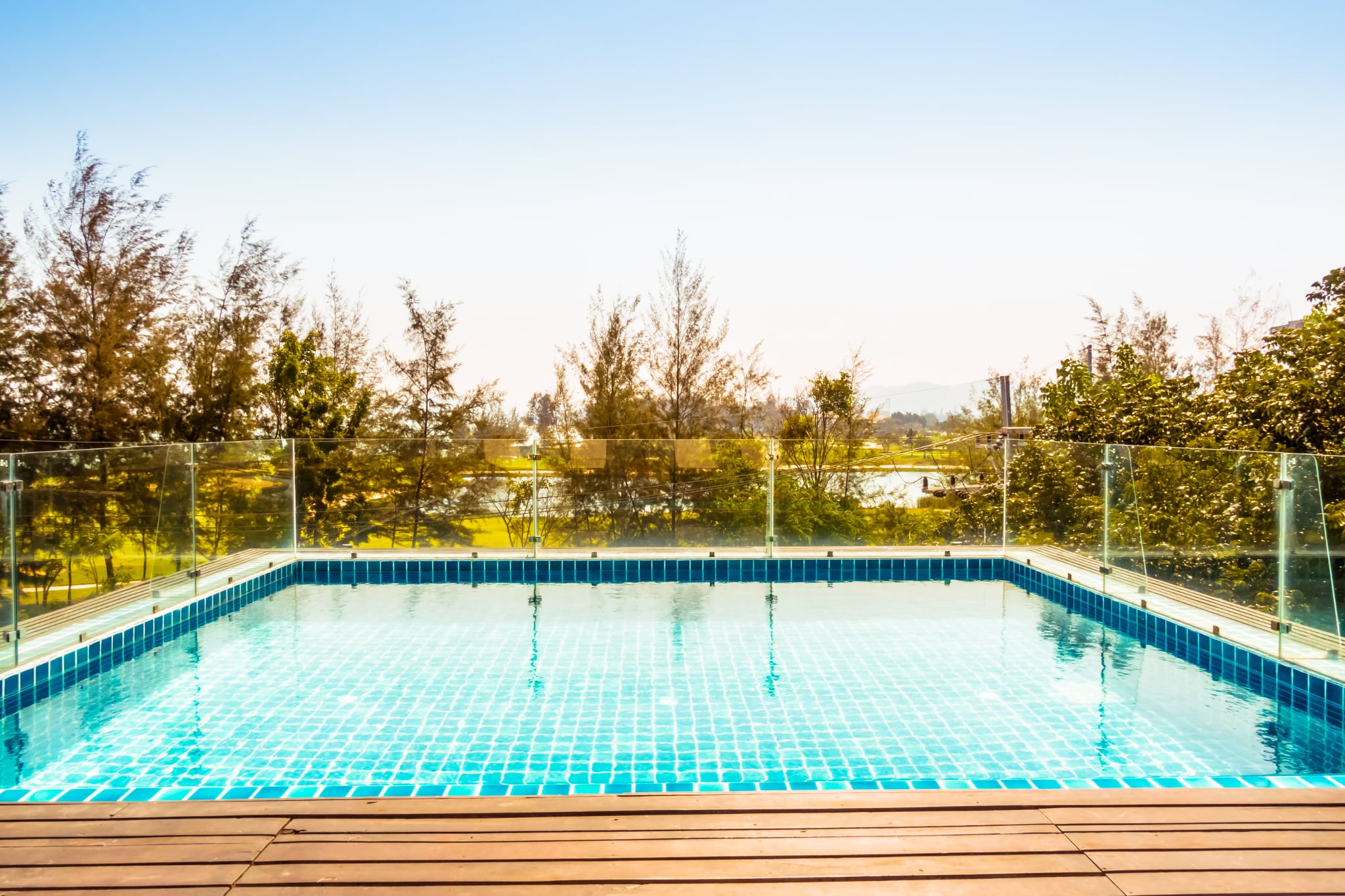

Most backyards aren’t perfectly flat. In Royse City and the surrounding Rockwall County area, newer developments are frequently built on graded lots with meaningful elevation changes across the property. Some have retaining walls separating the pool deck from the yard below. Others have a steady slope from one side of the fence line to the other or a yard that drops off sharply at the back. These aren’t unusual situations, but they do require a different approach than a standard-level installation.
Working with trusted glass fencing services ensures that sloped terrain is handled correctly. The good news is that sloped terrain is entirely workable with glass pool fencing. The key is understanding which installation method fits your specific grade and ensuring the person installing it has done it before.
The Two Approaches to Sloped Installation
There are two ways to handle a slope with frameless glass panels: stepped installation and raked installation. Each has trade-offs, and the right choice depends on your grade, your aesthetic preference, and your budget.
Stepped installation keeps each panel perfectly level and drops the height of the panel base at regular intervals to follow the slope, like a staircase. The panels themselves are standard rectangular cuts. The visual result is a clean, uniform fence line with a series of level steps that track the terrain. This approach is less expensive because the panels don’t require custom angled cuts, and it works well on gradual or irregular slopes where the grade changes direction. The challenge with stepped installation is managing the triangular gap that opens at the bottom of each step-down. That gap has to be addressed to maintain code compliance and keep small children and pets from squeezing underneath. We handle this with additional panel sections or solid infill at the step transitions.
Raked installation cuts the panels at an angle so the bottom edge follows the slope continuously, like a parallelogram rather than a rectangle. The result is a smooth, uninterrupted fence line with no visible steps. It looks cleaner on a consistent single-direction slope and avoids the gap management issue that comes with stepped installation. The trade-off is cost: every panel requires a custom cut, and that cutting must be done before the glass is tempered, so panels are ordered to exact specification with no room for field adjustments. A site measurement on a raked installation has to be precise before a single piece of glass is ordered.
For most Royse City properties with moderate slope, stepped installation is the practical choice. For steeper grades or properties where the pool design emphasizes clean visual lines, raked installation is worth the additional investment.
Footing Depth and Anchoring on a Slope
On flat ground, spigot depth and concrete footing requirements are straightforward. On a slope, the uphill side of the fence is under different load conditions than the downhill side, and that asymmetry has to be accounted for in the installation.
The downhill panels carry more lateral load because water, soil pressure, and gravity all work in the same direction. Spigots on the downhill side need to be set deeper and in denser concrete than they would on flat ground. We assess each installation individually and specify footing depth based on the actual grade, not a flat-ground standard.
Soil type also affects the anchoring approach. The Blackland Prairie clay soil that underlies much of Rockwall County expands when wet and contracts during dry spells, which is part of why foundations in this area require more engineering attention than other parts of Texas. That same movement affects fence footings. Clay soil that shifts seasonally can gradually work a spigot loose even if it was set correctly at installation. We account for this with appropriate footing diameter and concrete mix, and it’s worth raising the soil type question explicitly during a consultation if you’re on a lot with significant clay content.
Drainage at the Fence Base
Water runs downhill, which means the base of a fence installed on a slope is a natural collection point for drainage. On a poorly planned installation, water pools at the low end of the fence line, sits against the spigot bases, and accelerates corrosion of the hardware and degradation of the concrete footing over time.
The solution is to consider drainage as part of the installation plan, not an afterthought. On some properties, the existing yard drainage handles it adequately. On others, particularly where the fence sits at the base of a retaining wall or at the low point of a graded lot, a simple French drain or channel drain running parallel to the fence line keeps water moving away from the spigot bases. We’ll flag drainage concerns during a site visit if we see a potential problem.
Retaining Walls and Multi-Level Layouts
A number of Royse City properties have pools set into a slope using retaining walls, creating a split-level backyard where the pool deck is at a different elevation from the main yard. This is a more complex installation scenario than a simple sloped fence line, but it’s one we handle regularly.
The core question in a retaining wall installation is where the fence sits: on top of the wall, at the base of the wall, or at both levels. Each position has implications for panel height, gate placement, and how the fence integrates with the wall structure. A fence mounted to the top of a retaining wall needs to account for the load it transfers into the wall, and not every retaining wall is built to handle fence anchor loads. We assess wall construction before specifying anchor placement and may recommend core drilling into reinforced sections rather than the wall cap.
Bottom Gap Compliance on a Slope
This is the detail that most homeowners don’t think about, and that creates the most problems when it’s overlooked. The Texas pool safety code requires the gap at the bottom of a pool fence to be small enough to prevent a child from passing underneath. On flat ground, that’s easy to achieve and easy to verify. On a slope, the gap between the bottom of the panel and the ground changes continuously as the grade drops.
On a raked installation, the panel bottom follows the slope, and the gap stays consistent. On a stepped installation, the gap at each step transition can open up significantly and requires specific infill work to bring it back into compliance. A fence that looks code-compliant from a distance may have a single-step transition where the gap is twice the allowable clearance. We measure every transition point during installation and document compliance, which matters both for your family’s safety and for any inspection by local authorities.
What to Expect From a Site Assessment
If your property has a slope, a site visit before quoting is essential. We need to see the actual grade, the soil conditions at the fence line, where water drains, and how the pool deck relates to the rest of the yard. Attempting to quote a sloped installation from measurements alone leads to surprises during installation that are expensive to fix.
During a site assessment, we’ll walk the full fence line, identify the right installation method for your specific grade, flag any drainage or soil concerns, and take the measurements needed to spec the panels accurately. For raked installations, that measurement process is particularly thorough because every dimension has to be right before glass is ordered.
Related Topics: